Still in the Queensland sugar cane belt, Bundaberg is famous for its rum. You can't visit here without doing a tour of the rum distillery, which culminates in a free tasting. We did the tour at 10:00, and neither of us is very keen on rum, so we actually declined the tasting, although we did taste some molasses, which is rum's raw ingredient. Unfortunately one of the rules of the tour is that, due to the heady alcoholic fumed atmosphere, you can't take any electronic devices - cameras, watches, mobile phones all have to be lodged in a locker before you can enter the distillery. This means we don't have any photos of the distillation process, we have to be content with the 'Big Rum Bottle'!
Bundaberg also has a thriving ginger industry, and we visited the local ginger beer brewery. As well as naturally brewed ginger beer, they produce a range of other brewed soft drinks such as sarsaparilla and lemon, lime and bitters. Part of the tour (only a display in the visitor centre, unfortunately, not the actual factory floor) included a tasting of all their products, we left feeling rather bloated after all that soft drink. We also visited the local cooperage, where barrels are made for Bundy rum. Their main product is small kegs for use in the home, they were hard at it for the Christmas trade. We tried our hand at putting together a keg from pre-cut staves, it was like a jigsaw with numbers instead of a picture, we're not sure that our finished product would actually have been water (or wine) tight.


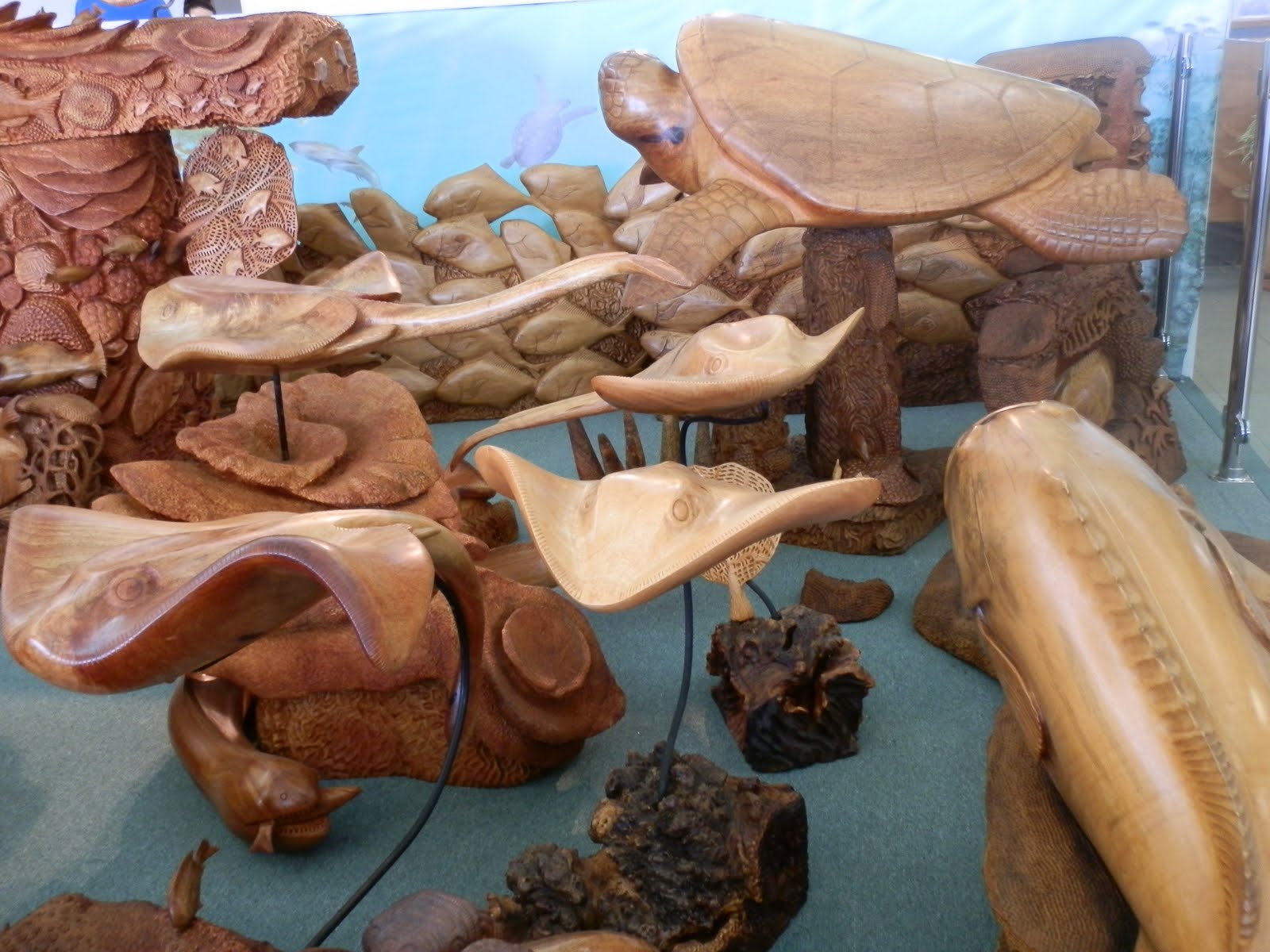
Bundaberg doesn't provide much in the way of local bush walking, but we did visit Sharon Gorge for a short walk (and an encounter with a rather large monitor) and the Mystery Craters, a bunch of holes-in-the-ground that, apparently, defy scientific explanation. We also visited Denizens of the Deep, a huge wood carving at the local council office, showing all things reef related.
We happened to be visiting Bundaberg in the middle of the season for the latest production of the local amateur theatre group. One of the things we miss about living on the road is live theatre, so we went along on Friday night. Apart from a few fluffed lines, they put on a terrific production, and we really enjoyed our theatrical experience.

The Mon Repos beach near Bundaberg is noted for turtles visiting to lay their eggs. The egg laying season only started recently, hatching doesn't start until January. We booked in for the 'Turtle Experience' with some trepidation, the 'experience' relies on whether or not turtles choose to visit the beach and lay their eggs that night. At the beginning of the night you get allocated to a group in the order in which you booked the 'experience'. Each group has around 50 people, and despite having booked almost a week earlier we were in Group 2. The local radio has a 'turtle report' each morning and we'd paid close attention with some trepidation - it appeared that the turtles frequently didn't visit until close to midnight. However, we turned out to be really lucky, Group 1 was called around 7:30, and Group 2 only about 10 minutes later. We all listened attentively to our instructions (keep together, no lights, don't approach the turtle until instructed) then moved en masse down to the beach. 'Our' turtle was a bit nervous, she tried 3 different nest sites before finally settling down to dig her nest and lay her eggs. Meanwhile Group 2 milled around in the dark on the beach, watching the night sky for shooting stars. Finally, a good hour or more after we had been called, we got to see 'our turtle'. At this stage she was still digging her nest, flicking the sand away with her hind flippers. We had to make sure we stayed out of her eye-line, to avoid spooking her, which meant that only about 1 quarter of the group could actually see anything at any one time. We rotated around as the turtle dug, flipped sand, dug, flipped sand..... Her hearing is at a different pitch to the human voice, so the ranger assigned to our group was able to speak in a normal tone explaining what was happening. Finally the nest was dug to her satisfaction and she started to lay her eggs. The rangers picked out some of the eggs from the nest and showed us - they were almost the exact size and appearance of table tennis balls, with a gooey coating. After she'd laid about 20 eggs, the ranger considered her to be committed to the operation, and we were allowed to spread out and watch her from all sides. Once she had laid all her eggs for the night and started to cover over the nest, we were allowed to take photos. The rangers also checked her health, measured her and recorded her vital details. The poor turtle suffered all the affronts to her dignity with aplomb, finally finishing her nesting and lumbering back to sea to cook up the next batch of eggs for laying in a few weeks.
The whole experience took over 2 hours, and ended up being even more interesting than we had hoped. 'Our' turtles hatchlings should emerge some time in January, hopefully they will all make it down the beach to the ocean, to return in about 30 years to start the cycle all over again. Returning back past the visitor centre to the car park afterward around 10:00 pm, we were glad we'd booked early - the people in group 4 were still waiting for 'their' turtle to emerge from the waves!

 One of the problems with living in the caravan is finding somewhere to spend school holidays. Anywhere on the coast tends to be a family holiday destination, and not only escalates in price but fills up with kids. This year we've decided to spend the Christmas period in Armidale, on the New England Tablelands in central NSW. Like most of the east coast, the summer is struggling to get started in Armidale. Most days we've been here have been fairly cool - we've even got out the winter doona again.
 On another day we drove 200km northwards to Tenterfield, made famous in the Peter Allen song 'Tenterfield Saddler'. The saddler's building is still there, with no resident saddler but still selling leather goods. Apart from the local heritage walk we also did an interesting drive around various granite outcrops and to the local lookout.