The trials and tribulations of Wendy and John on their Grey Nomad adventure around Australia.

Saturday, February 16, 2013

Finishing Up Our Around Australia Adventure

Almost exactly 4 years since setting off from Melbourne, we are finally finishing up our grey nomad adventure around Australia. Although not quite yet settled down in our new house, it is getting very close now and we won't be moving on in the van anywhere else. It has been a long and eventful time on the road, and we have thoroughly enjoyed it. The yellow lines on the map show where we have been with the van, which is almost everywhere there is sealed roads. We didn't do much of Victoria or coastal NSW, and didn't visit Tasmania at all, as we have seen most of these areas before we set off on this trip. The big swathes of Australia that we have missed tend to be remote and desert areas. We haven't marked the journey up Cape York which we did on an organised tour rather than taking our own van.

We've covered 130,000 kilometres on the trip, about 52,000 of which were towing the van, so the Patrol has had a good workout. We've been scrupulous about getting it serviced whenever due, and it has barely let us down. In that time we've replaced the clutch and the manifold gasket, and apart from that it hasn't missed a beat. As a reward, we'll be getting some of the panels replaced and the rest buffed and polished, given there are some very deep souvenirs of our various off-road bush adventures.

The van itself has also stood up fairly well to the journey, although the paintwork is a lot more faded than when we started (unfortunately we seem to have gone the other way, and are both rather more 'robust' than when we left Melbourne). We have had a few hiccups along the way, having to replace the hot water service and, twice, the fridge element, and repaired a couple of minor leaks. Still it has almost always kept the weather out and provided a comfortable home, and we have had no issues with it on the road.

We've spent most nights of our journey in caravan parks, having visited 137 different parks. Whenever available we have stayed in ensuite sites, which provide our own private bathroom (ranging from almost as large as a phone box to, rarely, quite palatial), otherwise we use powered sites, with only a handful of nights spent unpowered. Caravan parks have been by far our biggest cost on the road, almost twice as much in total as diesel, with the average cost of an ensuite site being about $38 a night, and a powered site $28.

We've seen and done many amazing things in the last 4 years. We've played golf on over 100 different courses, and gone walking in at least 200 national parks and reserves. We've been on boat trips, train trips and tram trips. We've been to the northern, western and eastern edges of the continent, and to the heart of the interior. We've taken nearly 2,500 photos (come around one night and we'll show them to you) and bought paintings, craft work and fridge magnets to remember it all by.

We've loved our around Australia trip and have memories that will last us a lifetime. We're now ready to move on to the next phase of our lives, and for the moment, leave the van behind and once again move into a house. We hope that anyone who has followed us on our journeys has enjoyed the experience, and who knows, maybe we'll see you out there on the track yourself one day.

Sunday, January 20, 2013

So Much To Do in Australia's Capital

We've had a fantastic 4 weeks in Canberra, and still haven't managed to see and do everything. One highlight of course has to be the reason for the city's existence - Parliament House. At this time of year the pollies are off on their annual holidays, but the building is still open to visitors. The iconic flag pole is visible from almost anywhere in Canberra, and the inside of the building is just as striking as the outside. Unlike Old Parliament House you can't actually sit in the chamber, but the current House of Representatives is a lot more modern and recognisably Australian, with a much less ornate (and more tasteful) Speaker's chair. But you don't want to be fooled into thinking that we the Australian people scrimped in the building's construction - the foyer contains more marble than you would have thought possible in one building.

The High Court is also currently in recess, but the lovely building is open to visitors, although we had to leave our water bottle at the front security desk. Who knows what it might have contained! The 'Treasures Gallery' at the National Library lived up to its name, with fascinating exhibits such as original 17th century Dutch maps (showing just tiny fragments of the Australian coastline), Captain Cook's log from his Endeavour voyage and the original manuscript of Waltzing Matilda. The Mint provided several hours entertainment watching the production of coins, alas no free samples on the tour.

One of the few places we had to pay for a tour was the Australian Institute of Sport, but the obvious disinterest of the 'guide', who was presumably fulfilling one of his duties as a resident athlete (in his case an AFL footballer, not what we would consider a good use of our tax money), and the limited access to the actual training facilities, made this a lowlight of our Canberra experience. More interesting were several CSIRO facilities, including the telescopes at Mt Stromlo that were burnt out 10 years ago and the 'Deep Space Complex' at Tidbinbilla, providing services to NASA monitoring various missions to Mars and beyond.

The ACT doesn't just provide indoor interest, we had 4 days bush walking in Namadgi National Park, and played golf at 8 different golf courses. All in all, we have thoroughly enjoyed our 4 weeks in Australia's Capital Territory,and could easily spend more time in a future visit.

Wednesday, January 16, 2013

Australian War Memorial

We've spent nearly 2 full days at the Australian War Memorial, and even then we probably missed at least half of what there is to see. It is the most amazing place, with displays ranging from vast quantities of memorabilia, to interactive displays, videos, photos, paintings, dioramas, sound and light shows ...... probably every form of display available to the modern curator, and possibly several more that no one else has thought of. It covers every conflict that Australians have been involved in, from pre Boer War before we were even an independent nation through both World Wars to the latest peace keeping missions.
 
The heart of the memorial contains the galleries with panels recording the name of every Australian who has died in conflict, surrounding the memorial pool and eternal flame, and leading to the shrine building holding the tomb of the unknown soldier. It is all incredibly affecting, and at the close of each day when the last post is played it would be a hard heart indeed who didn't reflect on the heroism of the countless soldiers commemorated here and the glory and futility of war.

Sunday, January 13, 2013

Surviving a Heat Wave in the Caravan

Like most of the rest of Australia, the weather in Canberra has been very hot this summer. In the three weeks we have been here, there have been only 6 days with a maximum under 30 degrees, and Christmas Day has been the only day with a maximum under 20. To cope with these temperatures in the van we need to be proactive with opening and closing windows, air vents and curtains, in order to maximise the breeze and minimise the sun. Although our site here has very little shade, the van is oriented basically east-west, which means at least we don't get much direct sun onto the windows. However, no matter how careful we are it isn't easy to keep the inside of the van cool, particularly on the days that have been in the high 30s.

The first time we turned the air-conditioner on after we first got the van it made a terrible racket.  Ever since we have tried to avoid using it whenever possible, for both our own comfort and that of others who are parked nearby. About 18 months ago, several years after we set off on our around Australia adventure, a neighbour remarked that it sounded like there was something loose in the airconditioner cowling. Sure enough, inspection revealed a missing screw, which explained the terrible rattling. Such a simple fix! We still avoid using the air conditioner when we can, as we much prefer natural ventilation, but at least we now have that option when the heat becomes unbearable, as has happened quite a few times in the past couple of weeks. At least being such a small area it cools down reasonably quickly, and once the outside air has cooled down to a reasonable temperature we can once again open all the windows and let the breezes through.

In contrast to the days here, most night in Canberra have been quite reasonable sleeping temperature, and we have slept under the doona for all except a few nights. However, there have been a couple of times when the night has been so warm as to make sleeping uncomfortable. Even with our quieter air conditioner we do not like to sleep with it on, so we have a tiny fan that years ago cost us $10 in Bunnings (the caravanner's friend) that clips on to a shelf above the bed. It's remarkably effective, the only drawback is that as the switch is on John's side of the bed if Wendy wakes up too cold and wants it switched off she either has to get up and walk around the bed or nudge John until he wakes up enough up to turn it off. Guess which option she usually selects?

Tuesday, January 1, 2013

Festive Season in the Australian Capital Territory

Christmas in Canberra has proved to be a quite different proposition from last year in Armidale. The weather has been fine and hot, which is just as well as we have been bowled over by the number of things to do here. As if all the things related to Canberra's status as the national capital aren't enough, the 'city in the bush' is within easy access of several national parks with lots of walking tracks and lookouts. We've made a list of the things we want to do in the ACT and it has quite a few more entries than we have days here, so it is going to be a very busy time!

Christmas Day itself was a very relaxing affair. We took advantage of being in a city to go out to one of the big-name hotels for a lovely buffet lunch, including lots of seafood as well as the classic roast meats and heaps of desserts. Luckily the local cab service was still running as the buffet also included Australian sparkling and table wine, it was no wonder that the hotel had tables over their entire foyer and not just the normal restaurant area.

We're way too busy to spend too much time celebrating the festive season. One of our first stops was the National Capital Exhibition, giving a fascinating history of the search for the site of a capital for the new nation after Federation in 1901, the international design competition for the city, and the subsequent slow progress in actual construction. In fact, 2013 is Canberra's centenary year, as the first foundation stone was laid in March 1913.

Another day was spent at the National Archives. We had expected to spend maybe an hour here, but ended up taking over 4 hours to check out the displays, and could be there still if we hadn't been kicked out at closing time! On display is only a tiny fraction of the millions of documents, photos, videos and data files stored at the archives, but each of them provides a fascinating glimpse into the nation's history. One of the files contained an extract of the documents generated when NASA asked if the prime minister wished to include a message to be deposited by the Apollo 11 astronauts on the moon: after a huge amount of backwards and forwards of suggestions, edits and alterations, the final message bore little resemblance to the wording that had been bandied around for most of the document trail.

The Parliament House building was opened in 1927, at which time the national parliament moved from Melbourne where it had been meeting since Federation. As the number of parliamentarians (and their staff members) grew, Parliament House had more and more trouble coping, until finally a brand new building was opened in 1988. We had intended 'doing' both the old and new Parliament Houses in the one day, but once again underestimated how much there was to see and ended up spending so much time in Old Parliament House that we still haven't got to the new one. The photos here show the House of Representatives, including the original Speaker's chair, a gift from Britain, and the Prime Minister's office, set up as it was when used by Bob Hawke, its last occupant. There were so many other things to see, including the Senate chamber, the tiny rabbit warren of the press gallery and countless displays about prime ministers, opposition leaders, speakers, parliamentary whips and almost anyone and anything else that had anything to do with parliament over the years. Even the outside of the building is steeped in history, we stood on the stairs where Gough Whitlam made his famous 'nothing will save the Governor-General' speech and could easily picture ourselves mobbed by reporters.

We've also managed to squeeze in the National Portrait Gallery (including the massive official portrait of the Queen in her diamond jubilee year) and a cruise around Lake Burley Griffin.

For a change of pace, the other day we headed out of the city to Namadgi National Park and did a 9km walk around old pastoral areas, complete with huts, bits of fencing and other farming remnants dating from the late 19th and early 20th centuries.

One of the attractive things about Canberra from the tourist point of view is that everything we have done so far has been free, apart from the lake cruise and a nominal $2 entry fee into Old Parliament House. No wonder we want to cram as much into our visit here as possible!

Sunday, December 23, 2012

Coffs Harbour to Canberra


The school holidays have started so we have fled Coffs Harbour. It occurred to us that we can't really say we have 'done' Australia when we haven't visited the capital, so we decided to spend 4 weeks in Canberra. At over 800 km the journey was too long to do in a day, but with the Sydney megalopolis at a bit over the half way point we were in a quandary as to how to break it up. In the end we decided we would stay the night at an overnight rest area at Ourimbah, about 60 km north of Sydney. However, when we arrived at the rest area we found it was a designated 'driver reviver' stop, and was heaving with travellers taking advantage of the free tea, coffee and bikkies. There wasn't enough room for us to even stop, let alone pull up for the night. We were in a real quandary as there were no free camps any further south until well past Sydney, and very few caravan parks. After several frantic phone calls we managed to find a site at a caravan park at Camden, about 70km south of Sydney. They made sure to say that the office closed at 6pm and we had to be there before then, but we had a good run through the city (luckily we'd decided to travel on a weekend) and arrived in time, albeit feeling a bit frazzled.

With not much more than 200km to travel today we decided to take the scenic route, diverting from the Hume Highway to visit towns such as Picton, where we did the town walk including the lovely railway viaduct above, Mittagong and Moss Vale. The highlight of the journey was definitely Bowral, childhood home of the most famous of Australian cricketers Don Bradman. We spent a couple of hours at the Bradman museum, with its displays of all things cricket and Bradman related.

Once back on the highway we ran into a massive storm cell, with hail stones not much smaller than the balls that 'the Don' faced in his career. It was quite scary and like many other travellers we pulled off the road for a while until conditions calmed down a bit. We've given the car and van a thorough inspection and neither seems to have suffered any damage from the experience, but our nerves may take a couple of days to recover!

Thursday, December 13, 2012

Family Christmas Get-Together

Last weekend we left the van at Coffs and headed down to Sydney for John's extended family Christmas get-together. This is the first time we've been in a position to attend this now-annual event, and enjoyed the chance to catch up with relatives that in some cases we hadn't seen for several years. There are certainly a lot of them these days, with nearly 50 people of all ages enjoying the occasion.

Once again John's sister Diane and her husband Steve provided us with terrific hospitality, we are looking forward to the day when we are finally in our own house and will be able to reciprocate. On Saturday we went walking with Diane in Brisbane Waters National Park, which sprawls across the area near Diane's house on the Central Coast, the weather was perfect for an interesting walk along several creeks and past lookouts and aboriginal carvings. Its amazing how much wonderful bushland in Australia can be found so close to suburbia.

Sunday, November 18, 2012

A Land of Flooding Rains

In the famous poem by Dorothea Mackellar Australia is described as a land of  'droughts and flooding rains'. Well we've seen evidence of drought in our travels, and the Coffs Coast is now providing the flooding rains. Last night we experienced 160 mm in less than 12 hours, and this morning looks like there might be more coming. The noise of such heavy rain is magnified on the caravan roof, at one stage we had the tv turned up to 100% volume and still couldn't make out the program. We spent half the night lying in bed listening to it pound down on the roof just a couple of metres above our heads, and feeling thankful that we have an indoor loo in the van so we didn't have to dash across the park in the downpour.

Amazingly, this morning the park shows little evidence of the overnight storms, apart from some very miserable looking folk huddled outside their soggy tents. Obviously this area is used to having to cope with Dorothea's flooding rains!

We're still at Coffs Harbour watching our house move slowly towards completion. We still don't have a hand-over date, but it certainly won't be this year, so we'll head off on the road again once the school holidays approach, and return at the end of January to, hopefully, move in within a week or two.

Thursday, October 25, 2012

Back at Coffs Harbour

We're now back at Coffs Harbour on the northern NSW coast, looking forward to the end of our travels around Australia. While we've been away for the last 6 months the builders were busy on our new house, it was very exciting for us to be able to see it for real instead of just in the photos they have regularly sent us.

We still don't have a hand-over date, and the thought of the Christmas break is looming larger in our minds. With all the trades shutting down for an extended period over Christmas and New Year, if we aren't in the house by mid-December then we probably won't be able to move in until February. Given Coffs is a big family holiday destination, the caravan parks here will fill with families and kids, as well as hiking their prices to stratospheric levels. Therefore if it comes to that we'll pack up and head off for a few weeks, to have one last caravan adventure before settling down.

Saturday, October 6, 2012

Dubbo

 Dubbo is only about 140 km from Orange, but being out of the mountains has given us much more acceptable temperatures. Although a city of 34,000 people, it doesn't have a lot to offer the tourist, but the golf course has 27 holes so we've had 2 games to make sure we saw the whole course.

Dubbo's main claim to fame is the open range zoo, which has been showcasing Australian and exotic animals since 1977. We haven't been to a zoo for a few years so decided to have a day out with the animals. Our day started very early as we rose at 5:45 in order to join the 6:30 am guided walk. We were glad we did, as we got to see quite a bit  'behind the scenes', and it is in the morning that the animals are at their most active. The meerkat troupe definitely stole the show, they would have to be just about the cutest animals on the planet, but the giraffe with his long blue tongue would have come in a close second.

Monday, October 1, 2012

Orange

Orange is in the Great Dividing Range less than 300 kilometres west of Sydney. The city is large enough to support 3 golf courses, so naturally we couldn't resist a visit. Had we realised that the elevation makes Orange one of the coldest places in the state outside the alpine region then we mightn't have been so keen. Several nights where the temperature dropped below freezing, and days that haven't managed to struggle above 11 degrees, with a biting cold wind making it feel even lower, have rather moderated our enthusiasm!

The first couple of days we were here we took advantage of the at that stage balmy weather to do some walking. We firstly tackled the interesting town heritage walk, showcasing a large number of attractive and imposing houses in the posh end of town, and old industrial buildings (now universally converted to retail or residential spaces) and workers cottages in the less salubrious areas. There was also a memorial to the great bush poet Banjo Patterson, who was born nearby.

The following day we went to Mount Canobolas State Conservation Area, only 12 km from town, to do a bit of bushwalking. On the way we stopped at The Pinnacle, which has a sharp climb to a lookout offering fantastic views over the surrounding farmland and distant hills.

When we arrived in Orange we found that it was a long weekend here in NSW, with today being the state Labour Day holiday. Furthermore, when we went to the closest golf course to inquire about getting a game we discovered that the 3 courses run a tournament over the long weekend, with a round at each course over the 3 days. We debated the merits of entering the tournament, given the weather forecast of a cold change and rain coming on the Friday, but decided that as the rain was meant to clear away on Saturday morning we'd give it a go, stipulating late tee times on our entry form. Sure enough, on Friday afternoon the winds started to howl, the temperature dropped and the rain pelted down, 46 mm of it by the time it stopped in the wee hours of Saturday morning. We woke on Saturday to weather that was cold but clear, and congratulated ourselves on our planning. We checked the weather report again before heading off for our first round - a few showers in the morning (which never materialised), clearing to a sunny afternoon. Well someone at the weather bureau needs some remedial training, because about 3 holes into our round the skies opened and it rained pretty well the entire way round. At one stage we even had hail. We were wearing just about every possible item of clothing we have with us in the van and were still frozen to the bone. Needless to say our golf scores didn't impress. Luckily the next two afternoons were sunny, although still cool, but unfortunately our golf didn't improve enough to enable either of us to step anywhere near the winner's podium.

Monday, September 24, 2012

Griffith

In 1817 the explorer John Oxley described the area where Griffith is now situated as "uninhabitable and useless to civilised man". However in the late 19th century the government saw the potential for irrigation using the Murrumbidgee River, and in 1912 the water flowed and the Murrumbidgee Irrigation Area (or MIA) was born. Following World War I the population was given a boost as many farms were provided to soldier settlers, the memorial in Griffith's main street shows a World War I soldier with his hand on a plow handing over  a weapon to his son to go and fight in World War II.
 
The MIA is an abundant producer of citrus fruits and other fruit and vegetables. The area also produces 60% of NSW's grape harvest, with wineries specialising in botrytis style dessert wines. We did an interesting tour of a local mixed fruit farm, complete with tasting of the various farm products (although we cautiously restricted our intake of the prunes), and have been particularly impressed by the local mandarins bought at the Sunday market - much sweeter and juicier than the specimens normally obtained at a supermarket. We also did the rather dull heritage walk around town, and the rather more interesting local scenic drive.
 
Cocoparra National Park (John Oxley again: "abandoned...by every living creature that is capable of getting out of them" - not a man who could be described as a visionary) is only about 25km from Griffith and provided us with some good walks along creek beds and climbing up to exposed ridges with terrific views across the fertile and colourful fields of the MIA.
 
On the way back from Cocoparra NP we took a 50km detour to the town of Leeton, intending to visit the SunRice visitor centre, which supposedly had displays on the local rice industry. However, when we got there we found the centre had closed last year, it would have been nice if the Griffith tourist brochure had been updated and saved us the journey.

Tuesday, September 18, 2012

Nuriootpa

Nuriootpa is at the top of the Barossa Valley, probably South Australia's most famous wine district. We've visited the valley several times before, most recently when we stayed at Gawler (which is at the foot of the valley) last year, but also in previous South Australian holidays. The Barossa specialises in full bodied red wine, we usually only drink white so weren't really interested in visiting any of the 77 cellar doors listed on the tourist map we picked up (besides, you'd need to stay for at least a month to do justice to them all). We did, however, stop at a couple of cool climate wineries as we drove through the Clare Valley on the way here, picking up some lovely crisp Riesling, which is much more to our taste.

Instead of wineries we explored some of the marked walking trails around the valley, and had several lovely lunches in the numerous cafes, pubs and boutique breweries that always go hand in hand with any wine district. Unfortunately the weather hasn't been particularly kind to us here, so we only got in one of the games of golf we had planned, however that turned out to be a profitable one as, although we both played pretty ordinarily, Wendy managed a good shot on the one hole that really counts and came away with a $75 voucher for winning the pro-pin.

Wednesday, September 12, 2012

Port Pirie

We had 2 very long days driving southwards from Alice Springs, and have now spent a few days in Port Pirie in South Australia to recover. Port Pirie is on the eastern shore of the Spencer Gulf, and apart from being the service centre and export hub for the surrounding farming country it also hosts the world's largest lead smelter. This plant processes and exports multiple minerals apart from lead, and dominates the skyline for many kilometres around. We did the tour, which unfortunately didn't allow us to get out of the bus or take any photos, or even open the bus windows. Given all the workers had to wear breathing apparatus to guard against poisonous lead dust, perhaps not opening the bus windows was a good idea after all.

Inland from Port Pirie is the southern section of the Flinders Ranges. We spent some time exploring the northern parts of these ranges at the very start of our grey nomad adventures, and took the opportunity now to see what the southern ranges had to offer. The northern Flinders Ranges is very rugged and isolated, with a few mining and pastoral settlements clinging to the dry unforgiving land. Imagine our surprise to find that the southern Flinders Ranges is lush farmland and rolling hills, with prosperous towns offering cafes, wineries, olive groves and local produce for sale. Luckily for us it also offers several national parks with good walking through gorges and up to lookouts, so we got the best of both worlds in our couple of days exploration.

We're now discovering the downside of coming down to the southern part of Australia. Not only have we experienced our first rain showers in nearly 5 months, the forecast top temperature for tomorrow is barely more than the lowest overnight low we've experienced in that time!

Friday, September 7, 2012

Finishing Off in Alice

We've had a very busy and active time in Alice Springs. Apart from our journeys to Chambers Pillar and Rainbow Valley, we've had multiple trips to the west of Alice Springs. If we'd planned our time a bit better we would probably have actually taken the van out to the far end of the West MacDonnells and based ourselves there for a few days, but we didn't think of that soon enough. As it is we've covered over 1,500 km in our 11 days here, which is an awful lot considering the amount of driving we did to get here from Darwin (and the amount we'll be doing after leaving here to head south to our next destination).

Although it looks like the remnants of volcanic action, Gosse Bluff is actually the remains of an impact crater from a comet that hit around 142 million years ago. The original crater must have been impressive indeed, even with the erosion that has occurred over that incredible amount of time the crater walls stand stark above the surrounding flat plains. Not surprisingly the crater is a deeply spiritual sacred site for the local Aborigines, and access is restricted to a couple of lookouts and a short walking track inside the crater walls. On the same day we also visited Redbank Gorge, doing the walk down the rocky and sandy creek bed to a permanent waterhole. A group of European backpackers headed down the walk just before us, when we arrived at the waterhole they were taking it in turns to leap into the waterhole (modestly attired in bikinis and bathers) then rush shrieking back to dry land. Even here in the red centre the water is barely above freezing, not a pleasant swimming spot even on the hottest days. The backpackers willingly informed us it was there first bathing chance for a couple of days, luckily we weren't there to swim, just look at the scenery.

Finke Gorge National Park is about 138 km west of Alice Springs. The last 16 km is a 4wd track that largely goes along the bed of the Finke River. The last 4 km of this track is so rough that it took us 20 minutes, but at the end is one of the wonders of central Australia - Palm Valley. This narrow canyon is home to a remnant population of cabbage tree palms and cycads, left over from a much wetter ancient time. The creek side walk leads beside the palm groves, then returns along the cliff edge, providing panoramic views across the palm trees. The rest of the park is more usual desert country, the other walk we did was beside the dry creek bed once it exited the canyon, and over typical red, sandy country.

Ormiston Gorge, at the western end of the MacDonnell Ranges, has an international reputation as a classic central Australian destination. The red cliffs, dry landscape and rugged countryside provide the quintessential red centre experience. We first did a short walk to a lookout with a beautiful ghost gum tree bravely clinging to the rock edge, then tackled the 7km circuit walk, through the ranges next to the gorge, then back through the middle of the gorge. The gorge portion was extremely tiring, involving not only slogging through deep sand, but scrambling over tumbled rocks and even at one stage wading through a freezing cold water hole. Luckily the water was less than knee high, apparently at some times it laps the crotch....

Apart from all the driving and walking, we've found some time in Alice to do some maintenance on the car and to have a couple of games of golf at the superb Alice Springs golf course. We now feel that we've 'done' this central Australian oasis, and have plenty of wonderful memories to take away.

Sunday, September 2, 2012

Chambers Pillar and Rainbow Valley


It's been over 3 years since we were last in Alice Springs, but not a lot has changed in Australia's unofficial capital of Central Australia. Last time we were here we pretty well saw most of the sights available in town, and spent only a single day in each of the East and West MacDonnell Ranges. This visit we have planned to spend more time exploring the stunning landscapes that surround this city in the middle of the desert.
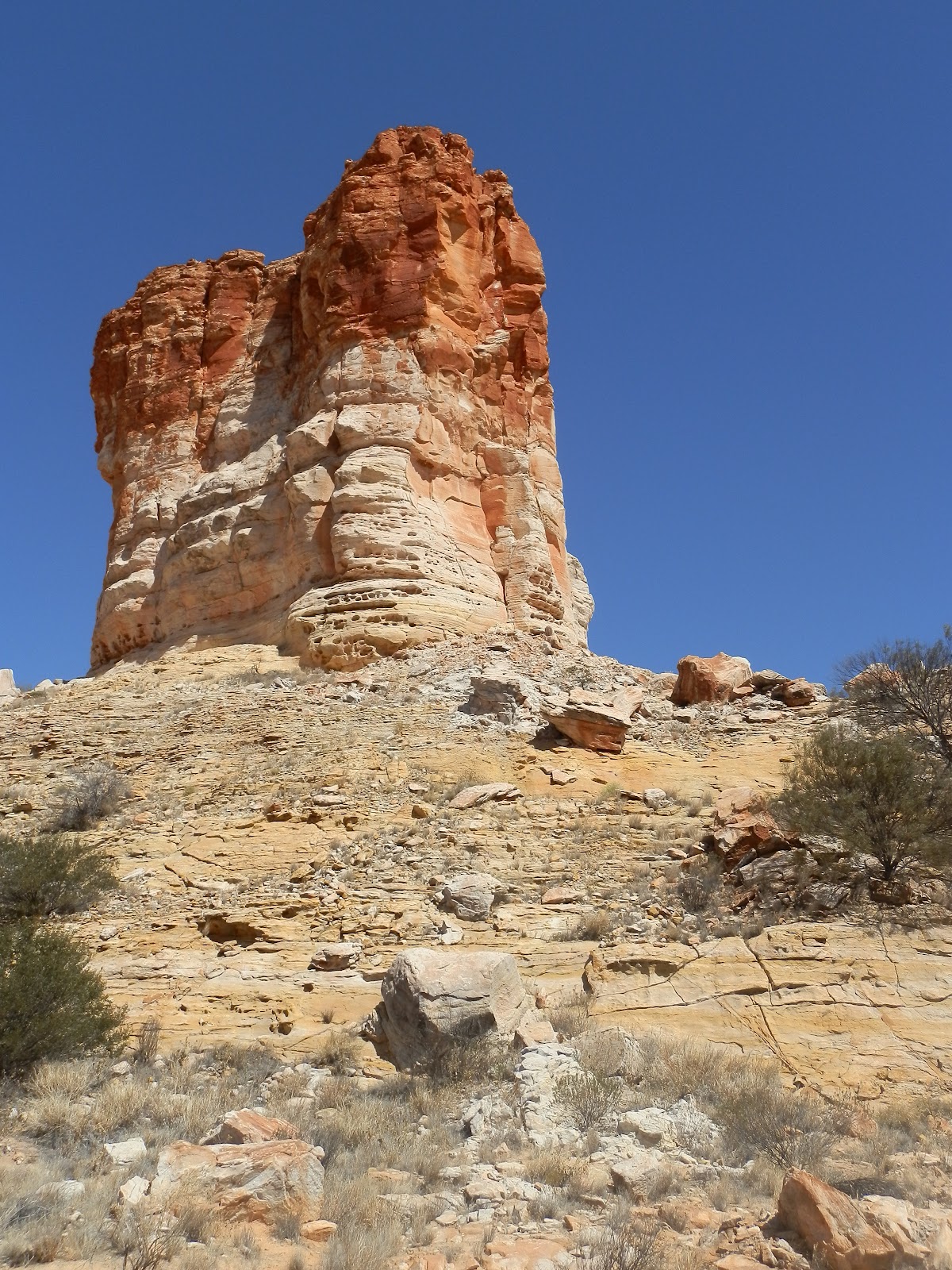
Chambers Pillar is about 160 km south of Alice Springs, accessed by a dirt road that deteriorates to a 4wd track for the last 40 kilometres. The photo at right (see if you can spot John waving) shows just how featureless the area around the pillar is, and gives an idea of how much of a landmark it is. The first white person to see Chambers Pillar was John McDouall Stuart, during his first attempt to cross Australia in 1860. It is a sandstone pillar that is capped by a hard iron-rich layer that has prevented the soft sandstone from eroding. Many travellers have carved their names into the base of the pillar, starting with the workers constructing the overland telegraph line in 1872, but this practice is now of course illegal and heavily discouraged. There is a walking track around the pillar and a platform built right against its base so you can get a close-up view of the historic (and not so historic) graffiti.
 
On the way down to Chambers Pillar we stopped at the Ewaninga Conservation Reserve, which protects rock engravings (petroglyphs) created by the original Aboriginal people of the area. The carvings are on a small rock outcrop next to a clay pan - in this dry climate the clay pan would hold water for a considerable period after any rain, making this a favoured site for longer stays by the Aboriginal people and giving them some leisure time for recording their beliefs in the soft sandstone. The meaning of the petroglyphs is sacred and cannot be revealed to people not initiated into Aboriginal lore.
 
Rainbow Valley is another area where hard capping protects soft white sandstone cliffs. Although probably only about 50km from Chambers Pillar, it is accessed by a completely different road from Alice Springs, so we visited here on a different day. The colour variation of the cliffs has been caused by water. In earlier, wetter times the red iron of the sandstone layers were dissolved and drawn to the surface during the dry season. The red minerals formed a dark, iron rich surface with the leached white layers below.
Like the rest of Australia, Spring has arrived in the red centre, and even this dry, sandy place is producing a profusion of wild flowers. You have to look a bit harder to find them, but when you look in the right places there is a surprising variety of colourful blooms, determinedly continuing the outback cycle of life.

Tuesday, August 28, 2012

Down the Stuart Hwy - Darwin to Alice

We've now left Darwin and done a couple of solid days travelling south down the 1500 km of the Stuart Highway to Alice Springs. We've travelled the northern half of this route quite a bit in the last few years, but we hadn't seen the part south of the Barkly Hwy turnoff towards Queensland since we first came up through the centre over three years ago.  Accordingly we decided to pull off the road and investigate the 'historical sites' we went past, and found that not only had we forgotten most of them, some had actually been installed new since we came this way last. It seems that the Engineering Society of Australia has been putting up lots of information boards recently, so we discovered new information on places such as the point where the north and south construction of the overland telegraph line joined in 1872, and one of the many wells dug along the overland telegraph route.

We also detoured into Newcastle Waters, the remains of a once thriving settlement that serviced the drovers taking cattle from the Northern Territory to the southern markets. With the advent of sealed roads and road trains the droving industry collapsed - the Drovers Park at Newcastle Waters has a memorial statue commemorating this quintessentially Australian activity.

The Tropic of Capricorn runs just north of Alice Springs, so we've now left the tropics for what we expect is the last time on our Around Australia trip. The desert climate means we'll be snuggling up under the doona at night for a while, rather than sleeping with just a sheet as we have been doing for the last week or so in Darwin.

Friday, August 24, 2012

Finishing Up in Darwin

After 3 months enjoying Darwin's superb dry season weather, we are about to hit the road again. The caravan park, which a week or two ago was full to bursting, is now showing lots of empty sites - the grey nomad exodus back south has begun.

Once again we have enjoyed playing lots of golf, and our handicaps are reflecting the good dry conditions. We have also enjoyed the friendliness of the DGC members, and have felt quite at home here.

Like last year, we have enjoyed quite a few theatrical outings in the last 3 months. We went to three productions at the Darwin Entertainment Centre, including the latest David Williamson offering and an amusing Bell Shakespeare production of Moliere's School for Wives. The last 2 weeks have been the Darwin festival, and we've really indulged, attending 7 performances. Like most festivals there have been hits and misses, Tripod and La Soiree probably being the highlights. The festival is split across two main venues, both offering fantastic outdoor dining, so we've not only been getting a culture fix but a food fix as well.

Yesterday we thought our departure might be delayed when our PC abruptly died. One minute we were happily playing mindless computer games, the next staring at what might as well have been a house brick. A frantic run around today now sees us proud owners of a brand new laptop, with all our data retrieved from the old one. Now all we have to do is try and figure out how to make all the programs look and behave in the same way we are used to!

Friday, July 20, 2012

A Visit to Government House

We'd like to say that we received a special embossed and engraved invitation to tea at Government House with the NT Administrator Her Honour the Honourable Sally Thomas AM, but the reality is that today was the annual Government House Open Day, so we went along for a sticky beak.

The first Government House was built on this site in 1871, but this was pretty well destroyed by termites, so a more appropriate building was erected, completed in 1879. Cyclones, Japanese bombing in World War II and just the ravages of time have seen this building renovated numerous times, but at core it is still the 1879 structure. We were allowed to wander through several of the rooms, including the dining room which was all set up for tonight's official banquet and the guest bedroom, complete with huge canopy bed with a set of stairs to climb up onto it! One of the nicest features of the house is the huge verandah that wraps around 3 sides, covered with louvres that allow cool breezes to flow through the building but keep out the sun and wet season rain.

The house is perched on top of a hill with fantastic views across Darwin Harbour. The gardens that cover the hillside are full of winding pathways, hidden nooks and seats taking advantage of the view, which we shared with half of Darwin who had also come along for a look.

Note in the above photo the colour of the sky and John's attire of t-shirt and shorts - now that's what a Winter's day should be like!

Thursday, June 21, 2012

Fogg Dam

After nearly a month of playing golf and lolling about the caravan, yesterday we headed outside the Darwin city boundary to Fogg Dam, about 70 kilometres east. The dam was built in the 1950s to provide a year round water supply for an ambitious local rice growing project, by the time the project failed a few years later the wetlands created by the dam had become a dry season refuge for water birds so the area was proclaimed a conservation reserve.

The Northern Territory Parks and Wildlife Service run free ranger activities in various national parks throughout the dry season. We've attended quite a few of these in our previous Darwin visits, the talk at Fogg Dam being one of the few new ones for this year. As usual, we were the only people in attendance at the talk, where the ranger gave us exhaustive details on the birds that inhabit the wetlands, in particular the large and noisy magpie geese. Appropriately there were several of these foraging in the waters below the lookout where the talk was held, along with various ducks, egrets, finches, a beautiful spoonbill and even some brolga. After the talk we did most of the walks on offer in the reserve, wandering through the woodlands and rainforest areas around the wetlands. The walk across the dam wall was closed, as a large saltwater crocodile has apparently decided to take up residence and has a habit of sunning himself on the roadway, we kept the car doors and windows firmly closed as we drove across.

On the way home we stopped for a pub lunch in Humpty Doo, surely one of the silliest place names in Australia!

About Us

My photo
We set off on the grey nomad adventure on 17 March 2009. This blog shows photos and comments of our adventures.

Itinerary for Mail

Itinerary for Mail